
"Low latitude"
1000 article(s) found

Colombia Coffee Boutique Coffee Basics
Colombia Coffee Producers Association (Federación Nacional de Cafeteos de Clolambia), or industry abbreviation [FNC] staff introduced the two main varieties of Colombian coffee, Cadura and Colombia. Kadura was introduced from Brazil in the 1960s and now accounts for 45-50% of Colombia's production, replacing the earliest Tibica. A new breed of the same name as Colombia [Colombi

Colombian Coffee Coffee basic knowledge
The Colombian Coffee producers Association (Federacion Nacional de Cafeteos de Clolmbia), known as [FNC] for short in the industry, introduced the two main varieties of Colombian coffee, Kaddura and Colombia. Kaddura, which was introduced from Brazil in the 1960s, now accounts for 45-50% of the country's output and has replaced the earliest Tibica. A new variety with the same name as Colombia [Colombia]

Boutique coffee beans introduce Colombian coffee
The Colombian Coffee producers Association (Federacion Nacional de Cafeteos de Clolmbia), known as [FNC] for short in the industry, introduced the two main varieties of Colombian coffee, Kaddura and Colombia. Kaddura, which was introduced from Brazil in the 1960s, now accounts for 45-50% of the country's output and has replaced the earliest Tibica. A new variety with the same name as Colombia [Colombia]

What is the uniqueness of Colombian coffee? Colombian coffee and its
The Colombian Coffee producers Association (Federacion Nacional de Cafeteos de Clolmbia), known as [FNC] for short in the industry, introduced the two main varieties of Colombian coffee, Kaddura and Colombia. Kaddura, which was introduced from Brazil in the 1960s, now accounts for 45-50% of the country's output and has replaced the earliest Tibica. A new breed with the same name as Colombia [Columby]

Boutique coffee beans recommend Colombian coffee growing environment Colombian coffee quality Columbia
Colombia's coffee production has been in a tug of war with Vietnam in recent years, but two ○○ three to two ⊙⊙ was squeezed out by Vietnam in seven years, ranking the third largest producer in the world. Costa Rica is determined to regain its position as the second place, and the second ○○ has worked out a plan to increase production in six years, and is determined to increase its annual output from more than 12 million bags to more than 16 million bags within five years, and win back the world runner-up. In the past, Costa Rica paid more attention to bulk merchants.

Which countries and regions can grow coffee? Why? Where does coffee come from? Coffee
Since coffee trees are tropical plants, they need to be planted in warm places. The main planting area is distributed between latitude 25 south and latitude 25 north with the equator as the center, so this area is also called the coffee belt. However, even in the coffee belt, Arabica and Robeska do not grow in exactly the same area, but grow up in an environment that is more suitable for their own growth.

Coffee beans recommend the unique geographical environment of Colombian coffee.
Costa Rican coffee production has been in a tug of war with Vietnam in recent years, but two ○○ three to two ⊙⊙ was squeezed out by Vietnam in seven years, ranking the third largest producer in the world. Costa Rica is determined to regain its position as the second place, and the second ○○ has worked out a plan to increase production in six years, and is determined to increase its annual output from more than 12 million bags to more than 16 million bags within five years, and win back the world runner-up. In the past, Costa Rica paid more attention to the commercial soybean market.

Costa Rica Amapola Estate Coffee How to Drink_Costa Rica Tara Beads Coffee Brewing Advice
Professional coffee knowledge exchange More coffee bean information Please pay attention to coffee workshop (Weixin Official Accounts cafe_style) Costa Rica Costa Rica is located in the isthmus of Central America, 10 N, 84 W. East Caribbean Sea, west of the North Pacific Ocean, located in Central America's low-latitude volcanic belt, the central plateau and mountains about 8002000 meters above sea level, suitable for coffee growth. Costa Rica's

Colombian Coffee in Consacapoland Manor tastes Colombian Coffee Culture
Professional coffee knowledge exchange more coffee bean information please follow the coffee workshop (Wechat official account cafe_style) Colombia is rich in coffee production, has always lost only to Brazil, is the second largest coffee producer, however, between 2003 and 2007, it was overtaken by Vietnam and is now the world's third largest coffee producer, and more than 2 million people in Colombia rely on coffee production.

Introduction of Colombian coffee boutique coffee beans
The Colombian Coffee producers Association (Federacion Nacional de Cafeteos de Clolmbia), known as [FNC] for short in the industry, introduced the two main varieties of Colombian coffee, Kaddura and Colombia. Kaddura, which was introduced from Brazil in the 1960s, now accounts for 45-50% of the country's output and has replaced the earliest Tibica. A new breed with the same name as Colombia [Columby]

Colombian coffee has a unique geographical environment Colombian boutique coffee beans Colombian coffee
Costa Rican coffee production has been in a tug of war with Vietnam in recent years, but two ○○ three to two ⊙⊙ was squeezed out by Vietnam in seven years, ranking the third largest producer in the world. Costa Rica is determined to regain its position as the second place, and the second ○○ has worked out a plan to increase production in six years, and is determined to increase its annual output from more than 12 million bags to more than 16 million bags within five years, and win back the world runner-up. In the past, Costa Rica paid more attention to the commercial soybean market.
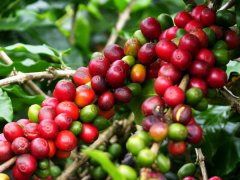
Which countries and regions can grow coffee? What conditions do you need to grow coffee?
Since coffee trees are tropical plants, they need to be planted in warm places. The main planting area is distributed between latitude 25 south and latitude 25 north with the equator as the center, so this area is also called the coffee belt. However, even in the coffee belt, Arabica and Robeska do not grow in exactly the same area, but grow up in an environment that is more suitable for their own growth.
Pu 'er Coffee_Baidu Encyclopedia Pu' er City makes every effort to build the brand of "Pu 'er Coffee"
Pu 'er coffee, as its name suggests, is a coffee produced in Pu' er City, beautiful Yunnan Province. Pu 'er coffee has a unique taste and is highly praised by coffee professionals at home and abroad. Pu 'er is a beautiful and rich land with superior ecology, rich resources and rich products. Pu' er City is located between 22 ° 02 minutes north latitude and 24 ° 50 minutes east longitude, and the Tropic of Cancer runs through it.

Low bitterness Columbia Hope Manor Coffee Variety Flavor description Fine Coffee beans
The suitable climate in Colombia provides a real natural pasture for coffee. Coffee trees in Colombia are mainly cultivated in the Andes, on steep slopes about 1300 meters above sea level, where the annual temperature is about 18 degrees Celsius, annual rainfall is 2000 to 3000 millimeters, latitude 1-11 15 north, longitude 72-78 west, and the specific range of elevation can exceed 2.000 meters. By
Colombian coffee beans Arabica coffee beans Colombian flavor
Introduction] the Colombian Coffee producers Association (Federacion Nacional de Cafeteos de Clolmbia), known as [FNC] for short in the industry, introduced the two main varieties of Colombian coffee, Kaddura and Colombia. The Coffee producers Association of Colombia (Federacion Nacional de Cafeteos de Clolmbia), or [FNC] for short in the industry, introduced

Introduction to Fine Coffee-- basic introduction to Colombian Coffee
The Colombian Coffee producers Association (Federacion Nacional de Cafeteos de Clolmbia), known as [FNC] for short in the industry, introduced the two main varieties of Colombian coffee, Kaddura and Colombia. Kaddura, which was introduced from Brazil in the 1960s, now accounts for 45-50% of the country's output and has replaced the earliest Tibica. A new variety with the same name as Colombia [Colombia]

Introduction to Fine Coffee-- Colombian Fine Coffee characteristics Colombian Coffee
The Colombian Coffee producers Association (Federacion Nacional de Cafeteos de Clolmbia), known as [FNC] for short in the industry, introduced the two main varieties of Colombian coffee, Kaddura and Colombia. Kaddura, which was introduced from Brazil in the 1960s, now accounts for 45-50% of the country's output and has replaced the earliest Tibica. A new variety with the same name as Colombia [Colombia]

Is there any suitable place to grow coffee in China? How to grow coffee beans correctly
Professional coffee knowledge exchange more coffee bean information please pay attention to coffee workshop (Wechat official account cafe_style) Coffee growing countries, Ethiopia, Costa Rica, Colombia, Kenya and other countries are world-famous coffee growers, coffee produced in these countries has been loved and pursued by people around the world, many cafes can see these countries

The characteristics of different kinds of coffee how many kinds of coffee are there? What kind of coffee is good? Different
As we all know, coffee is the product of 15 degrees north latitude from the equator, so it is produced in South America, Indonesia and Africa. However, the coffee produced from the equator to 15 degrees north latitude is so strong and bitter that only some people who drink coffee and do not know its taste will like it. In fact, the best coffee should be produced between 15 degrees north latitude and the Tropic of Cancer. Coffee is the product of the tropics, said

Colombian coffee has excellent conditions for the growth of boutique coffee.
The Colombian Coffee producers Association (Federacion Nacional de Cafeteos de Clolmbia), known as [FNC] for short in the industry, introduced the two main varieties of Colombian coffee, Kaddura and Colombia. Kaddura, which was introduced from Brazil in the 1960s, now accounts for 45-50% of the country's output and has replaced the earliest Tibica. A new variety with the same name as Colombia [Colombia]